
Next event Mon 19 Oct 2026 · 18:00

When AI Insiders Blow the Whistle: How Worried Should We Be?

Insiders at the leading labs are warning that AI development has become dangerous, some say to the point of threatening humanity's survival. We'll separate the hype from what is real: what has actually happened, how seriously to take it, what it means for Europe, and what those of us outside the labs can usefully do.

About

About the Collective

We are a community of policy experts, researchers, and people from across civil society exploring what advanced AI means for Europe’s future.

Our focus is on exploring the profound societal impacts of Artificial General Intelligence (AGI)—AI systems capable of performing any intellectual task human beings can do. We convene, analyze, and debate this transition, advocating for proactive approaches that will safeguard people and society.

Why

Why this matters

We are at an inflection point. AI systems are crossing capability thresholds that, until recently, most experts placed decades away. The implications — for work, for power, for security, for Europe, and ultimately for humanity's ability to steer its own future — are still largely unprocessed by the institutions that will need to respond.

The Brussels AGI Collective exists to help close that gap: by bringing the right people together for conversations serious enough to matter.

01 AI is advancing faster than almost anyone predicted, with human-level systems possibly within a decade

In just a few years, AI systems have gone from narrow tools to general-purpose models that can write code, conduct research, and reason across complex domains. Leading forecasts now place AI matching or exceeding humans at most cognitive work somewhere between 2030 and 2040. Timelines remain uncertain, but the direction is clear: capabilities that seemed decades away are arriving much sooner than expected.


02 That transformation would reshape economies, security, and the balance of power

AI of this kind would not be just another general-purpose technology. It could reshape labour markets, scientific progress, military capability, and the balance of power between states. Alongside the opportunities come risks our institutions were not designed for: large-scale misuse, accidents in critical systems, concentration of power, systems whose behaviour we cannot reliably predict, and the loss of human control over them, which many researchers see as an existential threat.

03 Europe is not yet prepared for it, but the gap can still be closed

Europe lacks the strategic awareness, institutional capacity, and integrated strategy this transition demands. There is no Draghi-scale plan for AGI preparedness. But Europe still has serious assets: a strong research base, regulatory credibility, and a record of building institutions when it has to. The window is narrow, but it is still open.

Events

Our events

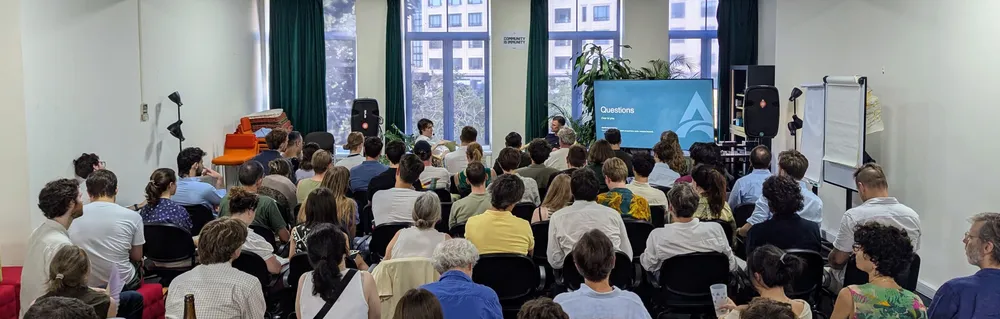
Each month we bring together people working on AI governance for an evening built around a recent report or a specific question, introduced by an expert who knows it closely. The format is a short presentation, then a fireside chat and open discussion under the Chatham House Rule. We avoid panels deliberately: rather than a series of brief exchanges, we want to give people time to set out a view, disagree carefully, and engage with the substance.

Mon 12 Oct 2026

How Europe Can Shape the Future of Work in the Age of AI

Menno Bart · The Adecco Group
David Timis · Brussels AGI Collective
Mon 19 Oct 2026

When AI Insiders Blow the Whistle: How Worried Should We Be?

Get notified of future events
Follow us on Luma Open calendar
Join

Stay in the loop

We host talks in Brussels every month. Follow us on LinkedIn for updates on upcoming events, recaps of past discussions, and occasional commentary on the big questions around advanced AI.